Breaking ground for Valley Church Center
-
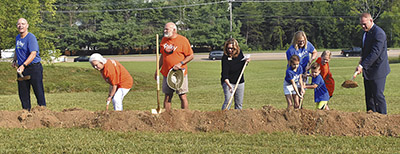
Those breaking ground for Valley Church’s new community center Thursday, July 29. included, from left, the Rev. John Gargis, church pastor; the Rev. Ann “Dindy” Taylor, Bishop of the Holston Conference of the United Methodist Church; her husband, Rusty Taylor, who oversees the Holston Conference’s congregational development; Kim Ponder, Valley Church’s director of family ministries; young congregants Willow Bennewitz, Ryker Nix and Alex Fout; and Knox County Mayor Glenn Jacobs. - Michelle Hollenhead
-
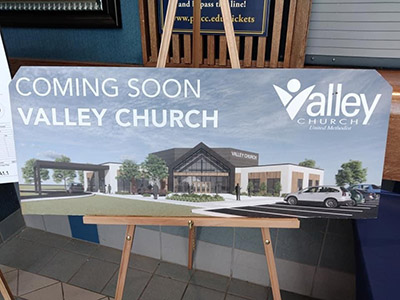
Architectural rendering of Valley Church’s community center, with a completion expected to take about one year. (Photo submitted) - Michelle Hollenhead
With a recent groundbreaking and a new charter, Valley Church is now official.
The Rev. John Gargis, church pastor, oversaw the ground-breaking ceremony on the church property, 11012 Hardin Valley Road, Thursday, July 29, where a community center will be built during the next year.
A collection of church members and local officials — along with several from host church Concord United Methodist — attended the ceremony, as did Knox County Mayor Glenn Jacobs, who also took part in the groundbreaking, as did Gargis; the Rev. Ann “Dindy” Taylor, Bishop of the Holston Conference; her husband, Rusty Taylor, who is over the Holston Conference’s congregational development; Kim Ponder, Valley Church’s director of family ministries; and three young congregants, Willow Bennewitz, Ryker Nix and Alex Fout.
“This vision started about 20 years ago,” Gargis said in a separate interview, noting the property was purchased by the Holston Conference of the United Methodist Church.
As plans were revived over the last two years, he was hired and hosted by CUMC, and began working in the Hardin Valley community just a few months before COVID-19 hit.
However, he and fellow workers persevered, contacting people via Facebook messenger as the congregation began to take shape.
“We launched the church during the pandemic, and the congregation was able to raise over a half million dollars in a few short months,” Gargis said.
Construction of the 1,200-square foot building, which will include worship space for up to 400 congregants, a commercial kitchen, offices, multi-purpose rooms and a lobby with “a coffee shop-like set up” is expected to take about a year, Gargis said.
“The community center is the initial construction and it is our hope the building will become just that,” Gargis said in a separate interview, adding, “The location of this building is placed strategically for campus growth.
“As Hardin Valley grows, Valley Church hopes to be part of the developing of this new community culture.”
A future Phase 2 plan includes a playground, a community garden, and an area for food trucks, with the pastor noting, “We have already cut a quarter-mile trail through the woods.”
On Aug. 1, the Sunday following the groundbreaking, Valley Church established its charter, making it a completely independent church and the 854th church in the Holston conference, officials confirmed.
Until the Community Center is completed in 2022, Valley Church worships in The Clayton Center at Pellissippi State Community College, 10915 Hardin Valley Road, Sunday mornings beginning at 11 a.m.