
Local Civil War history comes alive
Yet even amidst the cannon fire and casualties within the Civil War, there existed the same leadership problems Lowe saw through his 26 years in the U.S. Army.
“I love the lessons we can learn from that and apply
even today,” Lowe said. “The leadership struggles these guys had back in 1863 are the same leadership challenges that face us today. It doesn’t matter if it’s military or civilian — there will still be problems with how you treat subordinates, your superiors, communication. And logistics matter still, too.”
After Lowe relocated from Pennsylvania to Tennessee in 2015, those similarities inspired him to dig deeper into Civil War battles across East Tennessee — especially the Knoxville clash between Confederate Gen. James Longstreet and Union leader Ambrose Burnside.
In November 1863, Longstreet and his Confederate forces tried and failed to capture Knoxville from Burnside and Union soldiers. Longstreet’s delay in attacking ultimately allowed Burnside’s men to retreat and fortify, thus resulting in a disastrous assault on Fort Sanders that turned the campaign into a failure.
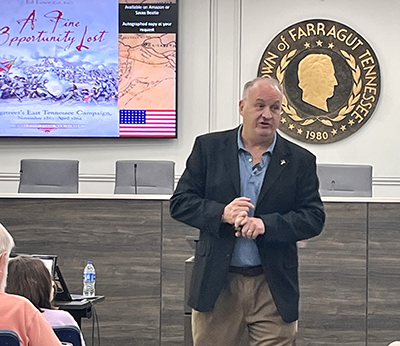
The different styles of leadership shown during that sequence inspired Lowe’s book, “A Fine Opportunity Lost,” leading him to present a lecture on that work and the battles within at the Farragut Museum’s History Hour on Wednesday, April 22.
His presentation is part of a monthly series the museum puts on, having begun the event with a presentation on Admiral Farragut last May after the museum reopened a month prior.
“We’re doing these history hours to talk about different topics, and we are really proud of the diverse topics we are covering,” said Kristi Vining, the Historic Resources Coordinator for the Town of Farragut. “This is on Longstreet’s campaign, but we have also done the life and legacy of Sequoyah and the women’s suffrage movement, among others.
“It’s something we’re really proud we can offer right here, and people are excited because you don’t have to go downtown and looking for parking. It’s a form of community outreach we’re enjoying.”
Audience members showed similar enjoyment, as several posed questions to Lowe near the end of his presentation.
That reciprocation left an impression on Lowe, who also serves as an adjunct professor at Elizabethtown College and the University of Maryland’s Global Campus.
“It shows that history matters,” Lowe said. “And as a 26-year veteran and retired colonel, I can empathize with some of the things (Longstreet) went through too. It stuck home with me.”