
Farragut officials seek answers after spill
-
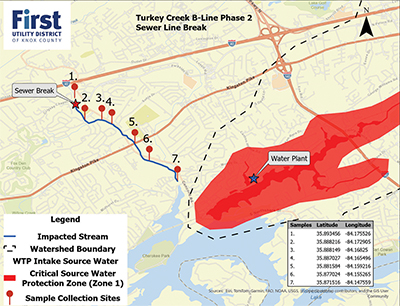
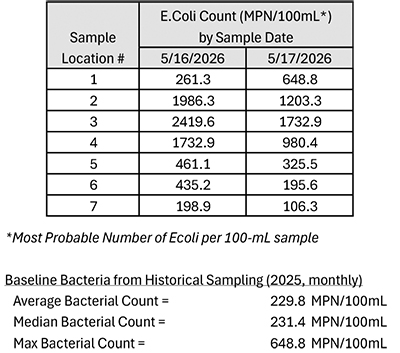
“For explanation in the provided chart, First Utility District included the mean, median and maximum values for the E. coli counts in the 2025 monthly sampling dataset for the creek at the Grigsby Chapel sampling location,” Edwin Deyton FUD engineering supervisor explained. “The creek sample data are inherently variable. For example, the average E. coli count was 229.8 MPN (most probable number per 100 mL sample), while the standard deviation was 171.8 MPN. E.coli counts can vary significantly from day to day, and even hour to hour, depending on factors, such as rainfall, temperature, stream flow, wildlife activity and runoff within the contributing drainage area. Given this natural variability, fluctuations in E. coli counts are not unexpected and are consistent with trends observed during routine sampling.” See also E. coli count chart. - Map provided by FUD
-
E. coli count chart - Map provided by FUD
-
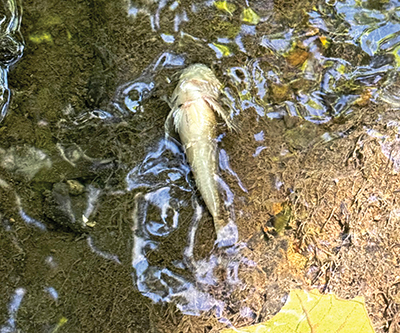
The Rekers family, who live at the north fork of Turkey Creek, found dead fish, such as this one, in Turkey Creek after the Friday, May 8, sewer pipe break, which caused a spill of sewage pollution into Turkey Creek. - Map provided by FUD
Farragut leaders expressed frustration, concern and urgency during a Board of Mayor and Aldermen meeting Thursday, May 14, following a sewer pipe break that contaminated the North Fork of Turkey Creek.
Aldermen and Town officials discussed cleanup efforts, public safety and long-term environmental impacts after residents reported dead aquatic life and strong odors in the creek.
“I think our entire community is outraged by what’s happened,” Alderman Joe LaCroix said.
Alderman Drew Burnette said he believed stronger measures were needed around the contaminated creek.
“I think FUD should come down there and block everything so nobody can get to that water,” Burnette said, adding he wanted ongoing water-quality readings published for the public. “I’m just not
seeing the activity that I think we should be seeing from the other agencies; so I think we have to
step in and have a point person … in the absence of their leadership, we need to step into that role as
much as possible and get that information out to the community.”
Alderman Alex Cain agreed with Burnette, adding,“It just seems like when you go by there, there’s nothing being done other than waiting for the water to flow through the creek,” Cain said.
Mayor Ron Williams suggested First Utility District use water hoses and chemicals to help flush and clean the creek.
Town administrator David Smoak said the Town’s stormwater coordinator responded after staff members learned of dead fish in the creek Friday, May 8. He said Town employees traced the problem upstream near Grigsby Chapel Road, where FUD crews had been working on a sewer line project.
Town staff then contacted First Utility District and the Tennessee Department of Environment and
Conservation.
Smoak said the Town has implemented internal changes to improve emergency communications and escalation procedures after hours and on weekends.
He added TDEC and FUD were monitoring bacteria levels in the creek and would determine when it is safe for the public to return.
After reaching out to FUD, Edwin Deyton, its engineering supervisor, responded, “First Utility District of Knox County is using a standard EPA-approved enzyme substrate test to measure concentrations of E. coli in Turkey Creek following the sewer leak.
“E. coli is a reliable indicator of fecal
contamination and is commonly used to evaluate water quality,” he said. “This is the same testing method used by FUD to monitor treated wastewater effluent discharged to Fort Loudoun Lake under FUD’s existing NPDES Permit.
“Sampling is being conducted daily at seven locations along approximately 1.5 miles of Turkey Creek, [as shown on the attached map], he said. “Testing begins at a point upstream of the sewer main break to establish background conditions and continues downstream to where the creek enters Fort Loudoun Lake.
“The ongoing monitoring program is intended to track stream conditions and evaluate recovery following the release,” Deyton said. “FUD has maintained historical test
data for E.coli counts within the stream, and the counts from Kingston Pike south to Fort Loudon Lake have
returned to historical levels. Counts between Grigsby Chapel to Kingston Pike are declining daily.”
Town attorney Tom Hale said TDEC has the primary authority to enforce corrective action and oversee remediation efforts.
Board members also raised concerns about environmental restoration and damage caused during the sewer project, including trees removed along the creek corridor.
“My concern is they went in there with a skid steer excavator, and whatever tree was in the way, they knocked it down,” Williams said. “Most of the time, when that kind of thing happens, they need to go back and fix what they tore up.”
Cain asked whether remediation would include physically cleaning the creek and restoring aquatic life after reports of sludge and widespread wildlife loss.
Smoak said many remediation decisions would depend on guidance from TDEC.
UPDATE (added Wednesday morning, May 20, after press time):
After reaching out, farragutpress heard from Jennifer Donnals, Tennessee Department of Environment and Conservation senior communications advisor, at 5:48 p.m. Tuesday, May 19 regarding the spill.
“Last Monday, May 11, our Division of Water Resources team responded to a sewer line leak in Farragut and confirmed First Utility District of Knox County repaired the leak by Monday afternoon [May 11].
“The utility placed warning signs and marker tape around the area of Turkey Creek to prevent public access,” Donnals reported. “TDEC informed the utility that warning signs must remain in place until stream samples for E. Coli downstream of the event are comparable to results upstream.
“We are seeing an improvement in the bacterial counts, but as of today, the samples have not yet returned to normal conditions,” she said Tuesday.
However, “This incident should have no impact on the utility’s drinking water system as Turkey Creek’s entry point into Fort Louden Lake is downstream of the drinking water intake. Any further requests for comment should be directed to First Utility District.”