
FUD says Turkey Creek E. coli levels declining
-
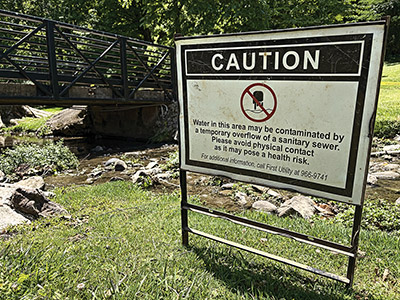
Daily testing continues at North Fork of Turkey Creek following the sewage spill. - Tony Cox
-
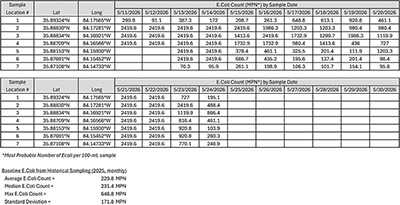
First Utility District’s daily readings show spikes but also declines since the sewer line break, which was reported May 11. The last lower number (195.1) on the first location (No. 1) shows the stream after the rain flushed out the stream, according to FUD general manager Bruce Giles. He added the spikes, such as those on May 12 and May 22, occurred because the rain brought in stormwater runoff. - Tony Cox
First Utility District’s daily testing of the North Fork of Turkey Creek continues following the May 8 sewer line break.
However, samples from the testing recently indicated a decrease in E. coli levels.
“We’ve been posting this information every day,” FUD general manager Bruce Giles said.
The break, which contaminated part of the creek and caused a loss of aquatic life along about 1.5 miles of
the waterway, was reported Monday, May 11, according to Town of Farragut and Tennessee Wildlife Resources Agency officials.
Giles, who said the work being done is on a 50-year-old sewer line, explained that “we’re replacing the length of the line over several phases.”
The leak occurred during that construction, but since the break, “we’ve been voluntarily sampling every day at seven sites,” he said. “On one site above the spill, where the break occurred, we were seeing that decrease, as expected, in all the samples, and the farther away from where the break was, the lower the numbers had been until the rain.
“When the rain came, all the samples spiked, including the ones above the [sewer] break,” Giles said. “I had people calling this weekend, asking questions.
“What people don’t understand is that creek has been impaired for years, and every time it rains, E. coli samples spike,” he said. “The numbers spike all up and down that creek. That has nothing to do with First Utility District.
“That creek has elevated E. coli numbers in it every time it rains,” Giles explained. “Just because it’s clear does not mean it’s clean, and that’s the same with most any water body. There’s always E. coli in that water.
“The numbers were extremely high for several days because of stormwater contamination,” he said, adding that contamination also emanates from silt, bacteria, wildlife, horses and dogs in the area.
“If animals have access to a stream … all that contamination runs into the stream,” he added.
“It’s been going on for years because every yard, every pavement, every parking lot, everything in that basin flushes, and all the contamination in all those spots flushes,” Giles said. “But we are seeing the numbers drop significantly, which is normal in an environment like that, with a creek like that, before the rain.”
Regarding the repair done to the pipe where the spill occurred, Giles said the repair was permanent, not temporary, as earlier reported.
“It was a replaced line,” he added. “I don’t know who made that comment … We actually went back last week and checked [the line] because of where it’s at.
“From the time we were
notified about the break, the time we had it repaired was five hours,” Giles said. “We actually had a berm built around it within three hours … if we had found out about this on Friday, there would have been minimal flow that hit that creek.”
He said sewer line breaks or other FUD-related problems can be reported by calling FUD’s 24-hour, 24/7 phone number, 865-966-9741.
Regarding the numbers in the results being posted, “it’s pretty complicated how it’s even done,” he said. “You’re looking at the concentration of E. coli through an [Environmental Protection Agency]-calculated number. It’s the same standard calculation that everyone in the United
States uses to calculate E. coli concentrations.”
On the table of results, the E. coli concentration was reported as 290.9 on May 11 in one location, then 387.3 on May 13 in that same location. It was 2,419.6 on May 21 and May 22 in that location, but it was 195.1 on Sunday, May 24.
“On May 24, you had the flush because you had all that rain,” Giles said. “You’ll see on May 21 and May 22, in column No. 1, that 2419.6, those numbers, the way the EPA standard method works, that’s the max it can read. My point to you is those numbers are above the break. Those have nothing to do with the [sewer line] break.
“That demonstrates that surface runoff is the primary, continuous source of the contamination,” he said. “There was a break, I own it, but this creek does this all the time … and it has for years.
“So, when people were saying that we created an environmental disaster, the reality is every time it rains, those numbers are bad,” Giles added. “I completely own and agree there was a sewer line break, absolutely, but what I’m trying to say is the conditions that we created with that break, there are E. coli concentrations as high as that in that creek multiple times a year because of stormwater runoff.”
Regarding the warning signs, "We followed what we were required to do,” Giles said. “I can’t answer that question [about signs other than Founders Park]. I don’t know.”
“I am aware someone trespassed on our property and put one at TDS Telecom [property]."