
Reveizes chronicle ‘journey of a lifetime’
Part 2: Across the Meseta (days 8–14, 107 miles)
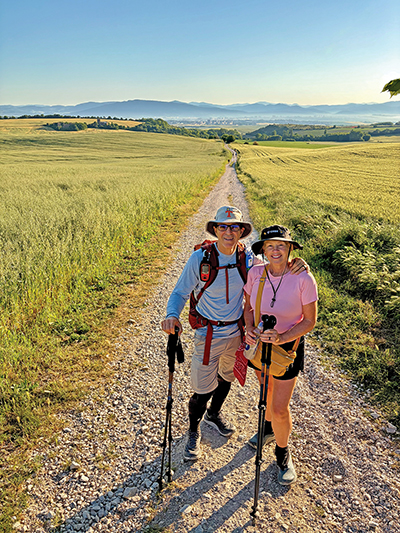
Veteran pilgrims often say the Camino de Santiago unfolds in three stages: physical, mental and spiritual. During our second week on the French Way, we continued through the physical stage while getting our first real taste of the mental challenge. Over seven days, Nancy and I covered another 107 miles, bringing our total to approximately 211 miles in just 14 days.
By now, our bodies were beginning to accept a new normal: waking up every morning around 4 a.m. and walking at least 15 miles before the day was over. Walking 15 miles once is an accomplishment. Walking 15 miles every day is an entirely different experience. Every morning our feet ached, our legs were tired
and yet somehow they carried us onward.
Along the trail, we met countless pilgrims struggling with blisters. Having learned a few lessons ourselves, we always stopped to help whenever we could. We shared blister tape, offered advice and stressed one important rule: the moment you feel a “hot spot” on your foot, stop
immediately and tape it before it becomes a blister. That
small decision can save days of pain.
One of the greatest surprises of the Camino has been the friendships.
Nancy and I continued walking with what had become our Camino family. Just one week earlier we had been complete strangers. Now it felt as though we had known each other for years. We often joked that one day on the Camino was equal to a year of friendship back home. Sharing the same challenges, conversations, meals and miles creates bonds that are difficult to explain unless you’ve experienced them yourself.
Since we began walking before dawn each day, the cafés were still closed when we set out. Every evening we would take inventory of whatever food we had left and share it together the following morning before heading down the trail. No one worried about who brought what — everyone simply shared.
There is something magical about walking through forests and centuries-old villages with only the glow of a headlamp or the light of a full moon to guide your way. The world is quiet. The only sounds are footsteps, birds beginning to wake and occasional conversations drifting through the darkness. It feels peaceful, mysterious and timeless.
Many people in the United States assume walking the Camino is similar to hiking the Appalachian Trail — carrying all of your food, camping gear and supplies while sleeping in a tent each night. In reality, the Camino is a completely different experience.
Pilgrims walk from town to town, staying in albergues (pilgrim hostels), guesthouses or small hotels, enjoying hot meals and a bed each evening. For those who prefer to travel lighter, luggage transport services move backpacks from one village to the next for about five to seven euros per bag each day.
That is one of the beautiful things about the Camino: it truly is your Camino. There is no right or wrong way to complete it.
Nancy chose to have her backpack transported each day while I carried mine. Neither choice was better — they were simply the choices that worked best for each of us.
This week also brought us to one of the Camino’s most famous and intimidating stretches — the Meseta.
The Meseta is the vast, high-altitude plateau that stretches across central Spain for roughly 136 miles. Known for its endless wheat fields, expansive skies and long, flat trails, it offers little shade from the relentless Spanish sun. Because of its repetitive scenery and challenging conditions, many pilgrims choose to skip this section altogether.
We couldn’t wait to experience it.
The Meseta proved to be everything we had imagined —beautiful, demanding, peaceful and somehow magical all at once.
While it certainly challenged us physically, it also became our first real mental test. Long stretches of trail disappeared into the horizon with little change in scenery, forcing us to focus less on the destination and more on simply taking the next step.
As a Camino family, we looked after one another. Every 15 minutes, a timer reminded us to drink water before we became thirsty. Every two hours, we stopped for a 15-minute break, taking off our shoes and socks to allow our feet and legs to recover before continuing. Those small routines made an enormous difference.
Our goal was never to finish that day’s walk.
Our goal was to arrive safely in Santiago de Compostela — more than 500 miles from where we had begun.
After approximately 211 miles over the first two weeks, every member of our Camino family remained injury-free. There were no major blisters, no serious setbacks — only sore muscles, tired feet and grateful hearts.
The Camino was slowly changing us.
The physical challenge was becoming routine. The mental challenge had arrived. And somewhere down the road, we knew the spiritual journey was still waiting.
Until next time... Buen Camino, my friends!