
Shell shares wealth of life’s stories in new book
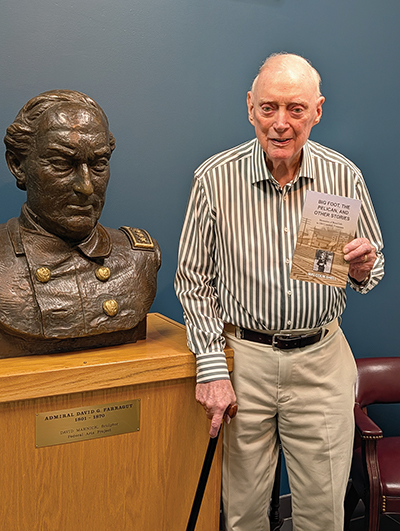
The book, which was released Thursday, July 2, is available at Farragut Museum and from Amazon, and people can meet the author at a book signing and party in Shell’s honor from 2 to 3 p.m., Tuesday, July 28, in the Museum, located in Farragut Town Hall, 11408 Municipal Center Drive.
A loyal supporter of the museum, Shell, 87, donated books to the museum that patrons can purchase.
For years, he has been writing articles for newspapers about Farragut and Old Concord.
“They were just stories that ran,” Shell said about the book’s contents. “I collected them.”
Kate Brewster, a Farragut Museum Committee member — as well as writer, researcher, speaker and retired librarian — compiled the stories into book form for Shell.
“She’s the one who really deserves the credit,” he added. “I owe it all to Kate.
“It was always something I wanted to do but didn’t think I could do it,” Shell said.
Brewster also is collaborating on another of Shell’s upcoming books, “Frontier Fort to Town Hall,” a brief history of the Town of Farragut starting in 1787.
“It’s stories about growing up in Old Concord and Farragut and some of the characters that were there,” Shell said about “Big Foot, the Pelican and Other Stories.”
In the introduction, Shell described Concord as a “small riverside town, which was founded in 1854 on land owned by James M. Rodgers.
“It was platted around and got its name from the existing Concord Cumberland Presbyterian Church located there,” he stated in the introduction.
“The early years of the town saw rapid growth thanks to the construction of the East Tennessee and Georgia Railroad,” Shell stated. “At its peak, the little town had several general stores, a drug store, bank and even an ice cream parlor.
“Concord was famous for its marble quarries,” he continued. “The highly sought-after ‘pink’ marble was used in the National Gallery of Art in Washington, D.C., and the New York Public Library’s famous ‘Patience and Fortitude’ lions.”
But the town changed when TVA built Fort Loudon dam a few miles upstream, and more than a third of the town was flooded.
One of Shell’s stories revolved around Concord Theater, which was located in the Masonic Hall on Second Drive and operated in the mid-century. Shell related the hall also served as a school for several years at the beginning of the 20th century. It also was the home of Concord United Methodist Church from 1870 to 1877.
However, “for the children growing up in the village, it was simply ‘the theater,” Shell related in the book.
He also told stories about Concord’s telephone company, its African-American community, constable W.O. “Pat” Patterson and when television came to the village, among many others.