Journey to Santiago
Reveiz shares part 4 of Camino Journal
-
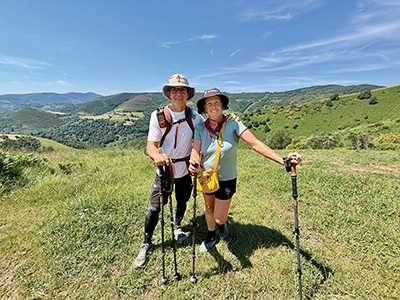
Carlos and Nancy Reveiz stopped for a picturesque photo during this portion of their trip along the Camino de Santiago. - Photos submitted
-
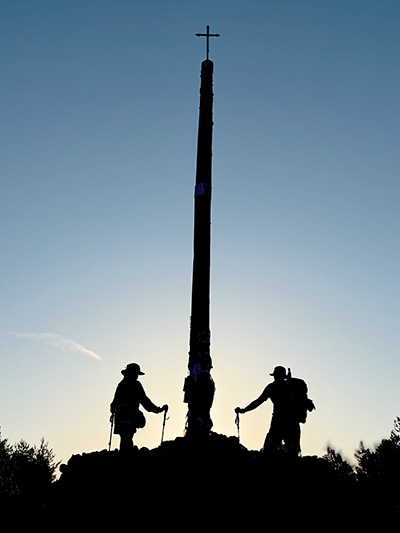
The Reveizes stopped at the Cruz de Ferro, a large iron cross, during their route. - Photos submitted
-
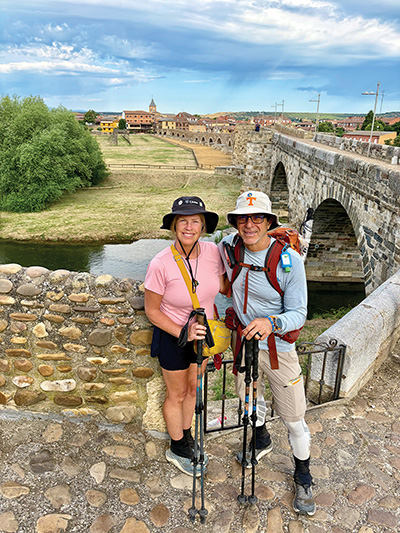
Carlos and Nancy Reveiz took a photo near the Puente de Orbigo, a medieval bridge, during their journey along the Camino de Santiago. Beside the bridge, there is a jousting track visible just to the left. - Photos submitted
After 28 days on the Camino, our journey was beginning to take on a deeper meaning than simply walking from St. Jean Pied de Port to Santiago de Compostela.
We decided to take a much-needed rest in the beautiful city of León. A few days before arriving, we discovered a donativo—a place where food and rest are offered to pilgrims in exchange for whatever donation they can afford. But this was no ordinary donativo. It was the actual home of a husband and wife who had walked the Camino themselves and wanted to give something back to fellow pilgrims. Their doors were open to everyone, and their kitchen looked like a buffet at Shoney’s! They were among the most caring and generous people we had encountered on the entire journey. The husband also hosted a weekly podcast and asked if the five of us would join him as a Camino family. He told us it was unusual for a group to remain so close and connected for so many days. So, while in León, we sat down together and shared our Camino story on his podcast.
Every morning before beginning our walk, the five of us would gather in a tight circle, place our walking poles in the middle, and Nancy would say a prayer asking the Lord to bless our journey. We quickly came to call this ritual “Sticks In.” As we left León, however, we were saddened that Melissa, one of our Camino family members, would no longer be walking with us. We came up with a way to keep her involved. We began hiding little surprises and notes along the route, then sending her pictures and Google pin drops so she could find them. It became our own Camino scavenger hunt — and our way of reminding Melissa that even though she was no longer walking beside us, she was still very much part of our Camino family.
Having finally completed the Meseta, the landscape changed dramatically. The flat, seemingly endless fields gave way to mountains, forests and ancient villages, each with its own unique character and history. We crossed the Puente de Órbigo, one of the longest and best-preserved medieval bridges in Spain, dating back to the 13th century. Centuries ago, jousting competitions were held near the bridge. Walking across it was surreal. Everywhere we looked, we literally were walking through history.
But one of the most anticipated moments of our journey was approaching — the Cruz de Ferro, the highest point on the Camino Francés. Standing nearly 5,000 feet above sea level, a simple wooden pole topped with an iron cross rises above a massive mound of stones left behind by pilgrims from around the world. For centuries, pilgrims have carried a stone from home and placed it at the foot of the cross, symbolically leaving behind burdens, regrets, grief or whatever may be weighing heavily on their hearts.
Nancy and I carried rocks given to us by our grandchildren. When we reached the Cruz de Ferro, we carefully placed those rocks among the thousands of others. As we stood there looking at that enormous pile of stones, we couldn’t help but wonder about the stories behind them. How much grief? How much pain? How many regrets, fears and burdens had been represented by those rocks over hundreds of years? The four of us stood quietly, taking it all in. Nancy and I hugged as we reflected on our lives, our children, our grandchildren, our future and our country. We thought we would simply place our rocks at the cross and continue walking. But the moment affected us far more deeply than we expected.
The following day, we ran into a man from Brazil whom we had met earlier on the Camino. He showed us a 7-pound rock he had been carrying in his backpack. He planned to leave it at the Cruz de Ferro the next day. We respected his privacy and didn’t ask what the rock represented. Later, he shared on Instagram that after placing the rock at the cross, he finally felt able to leave behind the pain, shame, anger and fear that had been weighing on his soul. It reminded us of something important: you never really know what someone else is carrying. Someone may look perfectly fine on the outside while quietly fighting battles we know nothing about.
From the highest point of the Camino came one of the most difficult descents. The next 2 or 3 miles were perhaps the toughest section we had encountered. The trail dropped steeply down the mountain over rocks of every size and shape. The Camino was testing us physically and mentally. But after 24 days and nearly 400 miles, our “Camino legs” were strong. We learned long ago not to worry about how far we had to go. We simply focused on the next step.
As we continued getting closer to Santiago, Ilona, our Dutch Camino family member, asked each of us what we thought our emotions would be when we finally entered the plaza in front of the Cathedral of Santiago de Compostela after walking nearly 500 miles. One by one, everyone answered. When it was my turn, I didn’t know what to say. Three years earlier, Nancy, my younger brother Luis and my 76-year-old uncle had walked approximately 200 miles from León to Santiago. So, unlike the others, I had already experienced the incredible feeling of arriving at the Cathedral de Santiago. But this journey had never been only about reaching Santiago for me. My goal was to walk 584 miles across Spain, beginning in France, crossing the country and continuing all the way to Finisterre — a coastal village that, thousands of years ago, was believed to be the end of the world.
Finally, our 33rd and final day of walking toward Santiago arrived. It was only a 13-mile day, but rain was forecast on and off for most of the day. The weather couldn’t dampen the excitement in the air. Hundreds of pilgrims seemed to have an extra spring in their steps. After weeks of walking, the goal was finally within reach. Our Camino family was filled with energy. The closer we got to Santiago, the more the excitement grew. I was happy, of course, but my mind was already looking beyond Santiago. For me, the ultimate destination was still Finisterre — the “end of the world” — another 84 miles and three days of walking away.
Then something happened that I nor our Camino family ever expected. As we reached Santiago in the rain, the outline of the cathedral emerged through the mist. Passing through the iconic tunnel, the resonant sound of a street musician’s bagpipes echoed off the walls. Suddenly, the energy shifted, and our group witnessed a moment that touched our souls in a way none of us saw coming.
And that…is a story for another day. Until then, my friends…Buen Camino.