
Spill case closed, but impact remains
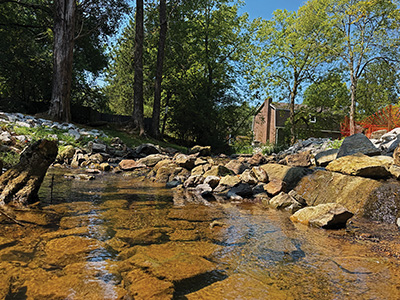
When Tennessee Department of Environment and Conservation “said we were all good, we went back to normal operations,” FUD general manager Bruce Giles said. “There’s really nothing [more to do] from our perspective.
“Once we resolved the short-term issue and made sure everything was good, TDEC closed the case, told us we were all good and we just kept moving along,” he said. “I think the creek’s right back to the same condition it was before. Like I told you before, it’s always been impaired.”
Likewise, Tennessee Wildlife Resources Agency assistant chief of the biodiversity division Jason Miller agreed FUD fulfilled its obligations.
About penalties reported regarding the spill, Miller said, “We don’t really describe it as a penalty.
“Essentially, we value the total loss of the resource, and of course, and fish and wildlife belong to Tennessee residents, so we just say [FUD] needs to remit to the agency the value of that loss because it’s not a purposeful pollution event or something like that,” he said. “We ask people to be responsible for attacks to the fish and wildlife. So, basically, we issued them $6,838.44 with the loss of fish species within that small stream, and [FUD] paid that immediately.
“We don’t call it a fine because it’s not a criminal thing,” Miller said. “That’s the impact to the resource, so we ask that they remit that to the state, and they did so.
“Most of the time with utilities, they fully understand,” he said. “My feeling is that they didn’t mean to do that. It was not something on purpose.”
Miller said the $6,838.44 goes into TWRA’s general fund for agency operations.
“It may not go directly into that stream,” he said. “Sometimes it will recover OK if you give it a little bit of time. A lot of these stream species are pretty quick to reproduce.
“After a year or two, it will repopulate that,” Miller said. “But, wildlife still has a value, so we want to recover that for the citizens of the state.”
Still, “we’ll kind of keep an eye on it,” he said. “It just depends on how it goes. From what I understand, it was mostly minnows and darter species and things. And a lot of times, those guys are really quick to repopulate. It may not require us restocking fish into the area.”
Attempts to contact TDEC were unsuccessful at press time.
According to a report by TWRA, Division of Water Resources was contacted “regarding a First Utility District of Knox County sewer line break located at approximately 11422 Grigsby Chapel Road, resulting in sewage entering North Fork Turkey Creek and the observation of dead fish,” Division of Water Resources representatives contacted Edwin Deyton, FUD engineering supervisor, for confirmation and additional information and “responded on site to Founder’s Park at Campbell Station.
“The division arrived on site and upon the observation of dead fish notified Tennessee Wildlife Resources Agency,” the report continued.
“Deyton stated that an easement was being cleared at the location of the line break on May 5 as a part of the ongoing sewer replacement project in the area,” the report stated. “Manholes in the area were inspected following the clearing and were free of mud at that time,” it continued. “It is believed that the ground compaction because of this clearing work caused the line to break on either [May] 6 or 7, which occurred below the ground surface after the contractor performing the clearing had left the area.
“FUD learned of the collapse on the morning of [May] 11, when they began to receive odor complaints,” the report stated. “A bypass to stop additional sewage from entering the creek was quickly established and the line was repaired by early afternoon.
“The spill resulted in a complete loss of aquatic life In North Fork Turkey Creek for 1.55 miles, 2494 meters,” according to the report. “The creek passes through Founders Park in Farragut. The length of the creek through this area was taped off with caution tape and signs placed warning against contact with the water.
“The bottom of the creek had so much sewage in it that most of the dead fish could not be seen,” it stated. “The fish that could be seen were in a decomposed state. Because of the ‘no contact’ with the water warnings, fish kill estimates were made using past TWRA survey numbers from the creek.”
TWRA estimated there were 5,032 dead fish.
When asked about the trees being cut down along the Grigsby Chapel greenway, Giles said the trees would not be replaced.
“The only trees that I’m aware of that were cleaned [out] were in our easement,” he said. “We’ve been there 50 years, and honestly, we should be keeping that easement clean for access anyway.
“If [the removed trees] are in the easement, the answer will be no [for replacing the trees],” Giles added. “That utility line and easement were there a long time before anything else was there.”